
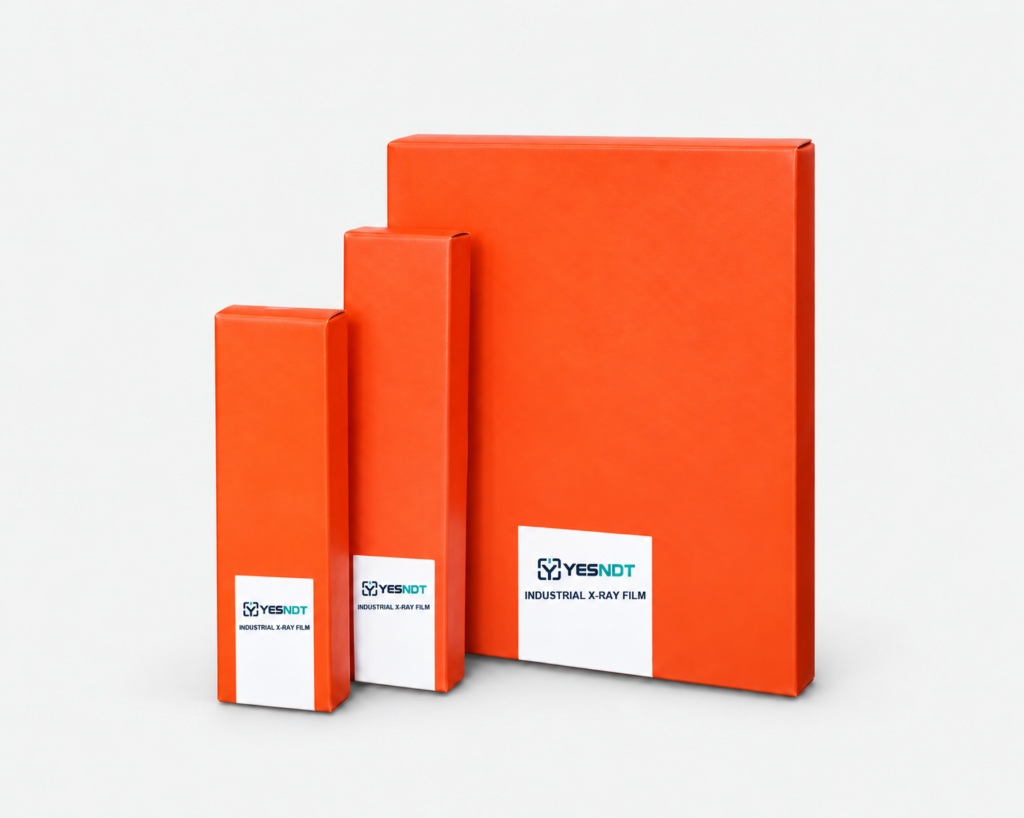
Technical data, image characteristics, exposure references and handling guidance for YESNDT industrial X-ray film.
Technical data, image characteristics, exposure references and handling guidance
YESNDT Grade and Brand Reference
YESNDT grade labels and the standards shown here follow the supplied YESNDT comparison chart. Competitor model names are reference points from that chart only; this is not a claim of exact equivalence, compatibility, certification, or affiliation.
| YESNDT | ISO 11699-1:2008 | EN 584-1:2006 | ASTM E1815-08 | GB/T 19348-2014 | Kodak reference | Fuji reference | Agfa reference |
|---|---|---|---|---|---|---|---|
| Y80HD | C4 | C4 | Class I | C4 | T200 | IX80 | D5 |
| Y100HD | C5 | C5 | Class II | C5 | AA400 | IX100 | D7 |
| Y7 | C5 | C5 | Class II | C5 | R400 | Q7 | E7 |
Package Specifications
| Models | Film size | Unit pack | Carton pack |
|---|---|---|---|
| Y7, Y100HD, Y80HD | 356 × 432 mm (14 × 17 in) | 100 | 4 |
| Y7, Y100HD | 305 × 381 mm (12 × 15 in) | 100 | 4 |
| Y7, Y100HD | 80 × 240 mm | 100 | 10 |
| Y7, Y100HD | 80 × 300 mm | 100 | 10 |
| Y7, Y100HD | 80 × 360 mm | 100 | 10 |
| Y7, Y100HD | 80 mm × 305 m roll | 305 m | 2 |
| Custom sizes available | Made to customer requirements | MOQ applies | Confirm with our team |
Source: YESNDT product information supplied by the user. Verify current production specifications and batch documentation before publication or quotation.
Film system grades
| YESNDT model | ISO 11699-1:2008 | EN 584-1:2006 | ASTM E1815-08 | GB/T 19348-2014 |
|---|---|---|---|---|
| Y80HD | C4 | C4 | Class I | C4 |
| Y100HD | C5 | C5 | Class II | C5 |
| Y7 | C5 | C5 | Class II | C5 |
Product overview
YESNDT industrial radiographic films are precision-slit and packaged from imported wide-roll master stock. The supplied technical data describes use with X-ray and gamma-ray sources for non-destructive testing. The film is characterized in the source data as high-sensitivity, high-contrast, fine-grain and high-definition, with a uniform coating and stable batch-to-batch image density.
Use and handling
Use
Keep film dry and protect it from static, heat and radiation. Maintain a clean operating area; prevent dust, powder and oil/grease contamination, and avoid localized pressure that could create image artifacts. Process exposed film promptly to limit latent-image fading.
Processed-film archive
After optimum development, fixing, washing and drying, store processed film in a clean, dry environment at 40-60% relative humidity, free from harmful gases. The source data states that properly processed film can be preserved for up to 50 years; actual archive life depends on processing quality and storage conditions.
Unexposed-film storage
Store unopened film upright and protected from light. Avoid localized pressure. Recommended general conditions: 10-24 °C and 40-60% relative humidity. Keep away from heat, radiation and harmful gases.
Safelight
Use a dark-red safelight filter with wavelength above 520 nm and a lamp below 15 W, positioned more than 1.2 m from the film. The source data also permits LED illumination in the 590-660 nm range. Avoid prolonged exposure under safelight.
Applications and scope
The source data describes the film family for routine industrial components and aerospace or military products, including detection of fine discontinuities. Stated applications range from light- to medium-wall metal sections using low-voltage X-ray to thicker or higher-density sections using high-voltage X-ray or Ir-192 gamma radiography. Direct exposure, lead screens and fluorescent intensifying screens are described as usable configurations.
Film base
Y7, Y80HD and Y100HD: 0.175 mm blue polyester base. Y7: 0.175 mm deep-blue polyester base. The source data describes dimensional stability for both base types.
Processing compatibility
The source data describes resistance to processing and compatibility with standard NDT processing chemicals, for manual or automatic processing. Processing settings differ by model; use the model-specific conditions on pages 6-7 and confirm chemistry, temperature and cycle with the processor.
General processing reference from the first-page table
| Mode / step | Temperature | Time |
|---|---|---|
| Manual development | 20 °C | 5 min |
| Manual fixing | 18-22 °C | 5-10 min |
| Automatic cycle | 26-28 °C | 8-10 min total cycle |
The general table is distinct from the model-specific processing tables later in this guide. Follow the applicable film and processor instructions.
Sensitometric characteristics
Original characteristic plots reproduced from the supplied technical leaflet. Curves are retained as supplied; film names and operating notes are identified in English below.
| Plot | English identification | Conditions stated in source data |
|---|---|---|
| Automatic-process family curves | Y7, Y80HD and Y100HD | Automatic development at 23 °C (73 °F), 120 s; lead screens, 0.03 mm front and rear; 60 cm film distance; source notes indicate 16 mA-min. |
| Manual-process family curves | Y7, Y80HD and Y100HD | Manual development at 20 °C (68 °F), 5 min; lead screens, 0.03 mm front and rear; 60 cm film distance; source notes indicate 16 mA-min. |
| Y7 sensitometric response | Y7, manual and automatic curves | Manual: 20 °C, 5 min. Automatic: 23 °C, 120 s. Curves shown on the source leaflet. |
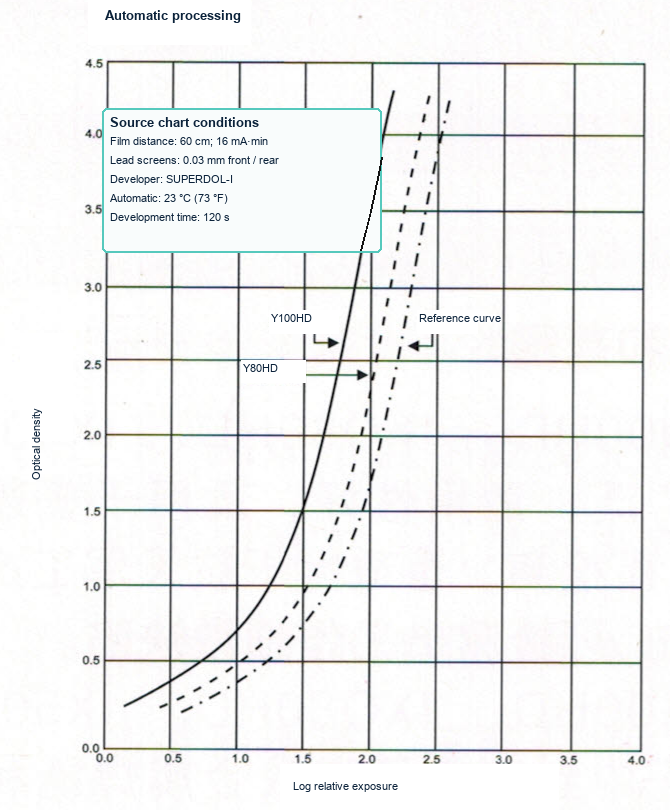
Family-film curve, automatic processing. Optical density versus log relative exposure.
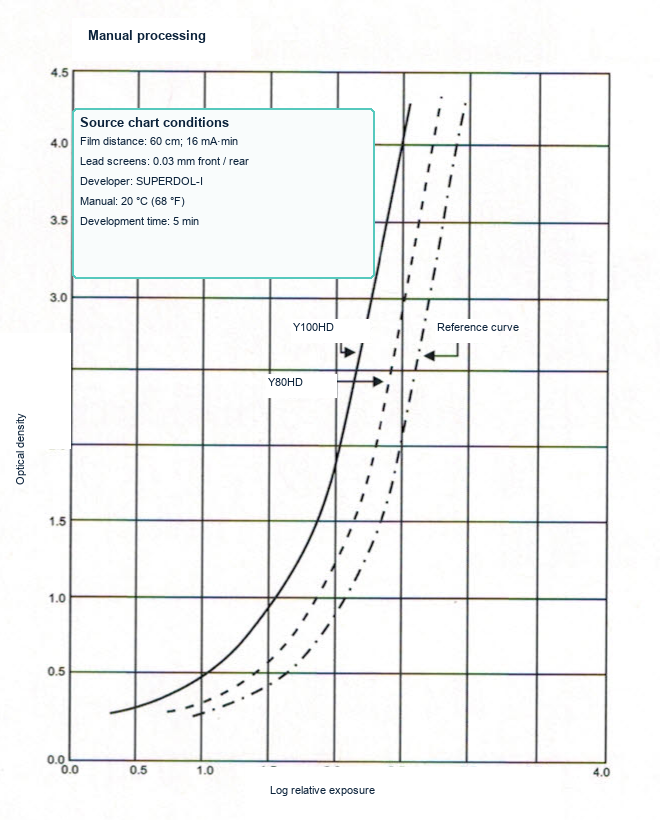
Family-film curve, manual processing. Optical density versus log relative exposure.
The Y7 source leaflet also provides a two-trace sensitometric plot; see the Y7 performance page.
Exposure curves and reference charts
The plotted data below is reproduced from the supplied leaflet. Exposure is affected by source, geometry, screens, processing and the required image density. Use the curves as starting references and establish job-specific technique by the applicable procedure and image-quality requirements.
Source and thickness charts
Left: X-ray exposure (mA-min) versus steel thickness; curves are labeled 160, 200, 240 and 300 kV. Right: Ir-192 exposure (Ci-h) versus steel thickness, to 90 mm.
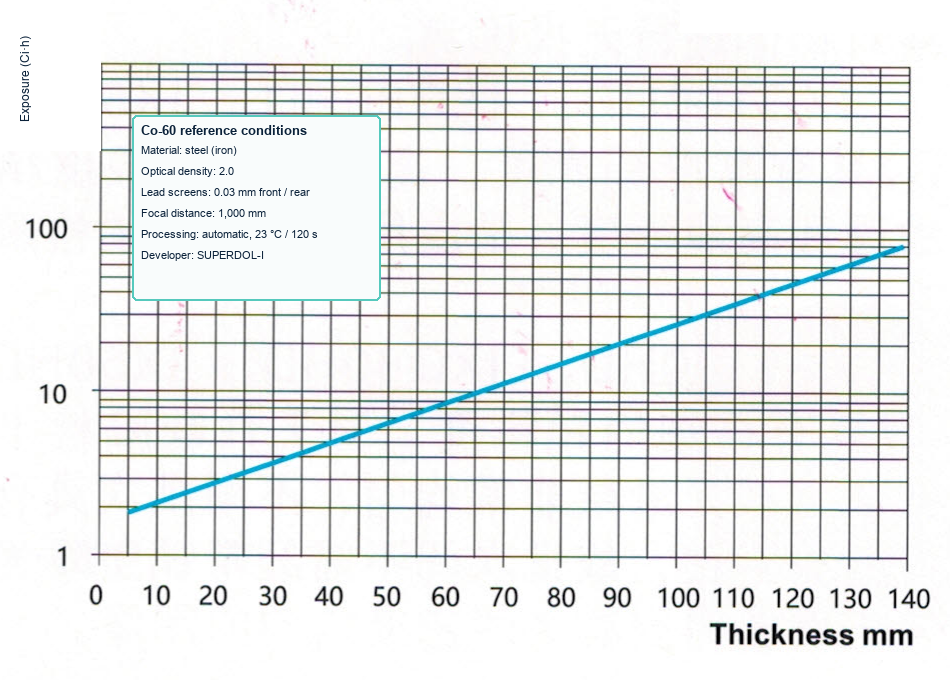
Co-60 exposure (Ci-h) versus steel thickness, to 140 mm.
Co-60 reference conditions shown in the source leaflet: steel (iron), optical density 2.0, 1,000 mm focal distance, lead screens 0.03 mm front and rear, and automatic processing at 23 °C for 120 s using SUPERDOL-I developer.
Tube-voltage and exposure-time references
The source plots pair X-ray tube voltage versus steel thickness with exposure (mA-min) versus steel thickness. The original curve identifiers remain visible in the reproduced scans; YESNDT grade names appear in the English headings.
Y100HD
Left: X-ray tube voltage (kV) versus steel thickness. Right: exposure (mA-min) versus steel thickness; curves are labeled 160, 200, 250 and 300 kV.
Source plotting conditions: 60 cm film distance, 16 mA-min reference, lead screens 0.03 mm front and rear, and automatic processing at 23 °C (73 °F) for 120 s.
Y7
Left: X-ray tube voltage (kV) versus steel thickness. Right: exposure (mA-min) versus steel thickness; curves are labeled 160, 200, 250 and 300 kV.
Source plotting conditions: 60 cm film distance, 16 mA-min reference, lead screens 0.03 mm front and rear, and automatic processing at 23 °C (73 °F) for 120 s.
Y80HD
Left: X-ray tube voltage (kV) versus steel thickness. Right: exposure (mA-min) versus steel thickness; curves are labeled 160, 200, 250 and 300 kV.
Source plotting conditions: 60 cm film distance, 16 mA-min reference, lead screens 0.03 mm front and rear, and automatic processing at 23 °C (73 °F) for 120 s.
Y100HD performance data
The statements below translate the supplied film performance data and are presented for the YESNDT Y100HD product. Comparisons are source-sheet claims, not independent test results.
Photographic performance
X-ray sensitivity: described as broadly similar to AA400 and C7, and about 10% higher than IX100. Gamma sensitivity: described as similar to AA400, about 20% lower than C7, and about 10% higher than IX100. For higher-energy sources such as Co-60, the source notes a slower sensitivity response.
Contrast / average gradient: described as nearly the same as IX100, AA400 and C7. Base-plus-fog density: approximately 0.25 after manual processing and 0.27 after automatic processing. Image quality: graininess and resolution described as comparable to AA400 and C7.
Processing conditions and system classification
| Processing mode | Temperature / time |
|---|---|
| Manual development | 20 °C / 5 min |
| Automatic development | 26-28 °C / 100 s |
| Standard | Classification |
|---|---|
| ISO 11699-1 | C5 |
| ASTM E1815-08 | Class II |
| JIS K7527 | T3 |
| GB/T 19348-2014 | C5 |
| EN 584-1:2006 | C5 |
The source warns that higher automatic-processing temperature or longer processing time may shift the achieved system classification.
Physical and image-quality characteristics
The source describes good film toughness and resistance to abrasion and scratches compared with Q7 and AA400, reduced sticking under high humidity, and less lead-powder attachment. It states that manual or automatic processing can produce uniform-density, clear images and that the film is designed for rapid development within standard processing time. Increasing development temperature or time is described as raising fog rather than substantially increasing image blackening.
Recommended handling
Follow the general storage and safelight guidance on page 1. Process exposed film promptly. Use the conditions above as the source reference and verify the complete film system classification under the actual processor setup.
Y7 performance data
Photographic performance
Sensitivity: the source states that Q7 is faster than E7 and slightly slower than R400; it does not provide a percentage for the difference. Contrast / average gradient: described as broadly similar to E7 and R400. Base-plus-fog density: approximately 0.20 after manual processing and 0.21 after automatic processing. Image quality: graininess and resolution described as comparable to E7 and R400.
Processing conditions and system classification
| Processing mode | Temperature / time |
|---|---|
| Manual development | 20 °C / 5 min |
| Automatic development | 23 °C / 120 s |
| Standard | Classification |
|---|---|
| ISO 11699-1 | C5 |
| ASTM E1815-08 | Class II |
| JIS K7527 | T3 |
| GB/T 19348-2014 | C5 |
| EN 584-1:2006 | C5 |
Physical and image-quality characteristics
The source describes Q7 as a different formulation from 100HD and IX100. It states better scratch resistance than 100HD and better abrasion resistance than E7 and R400. It also describes consistent density and clear images under manual or automatic processing.
Y7 sensitometric curve
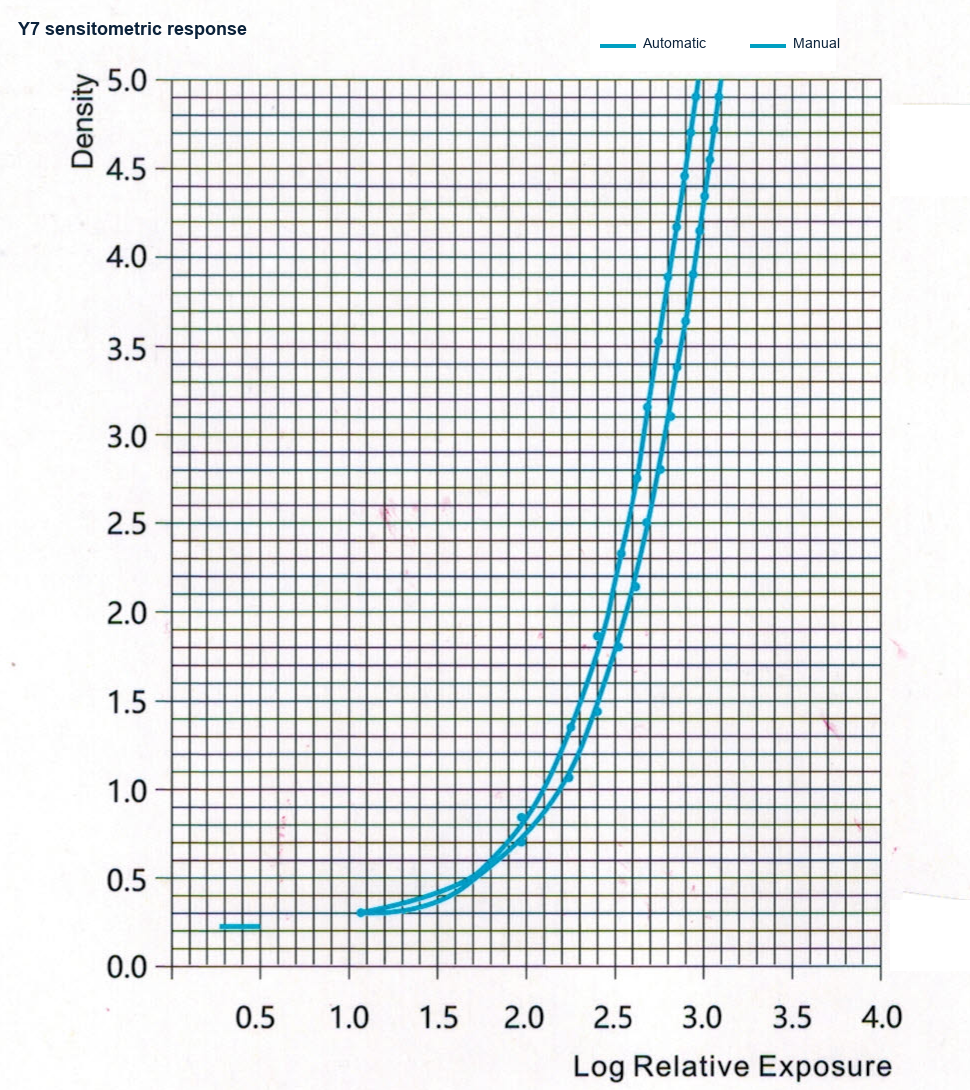
Manual and automatic sensitometric traces; optical density versus log relative exposure.
Use and storage
Store at 10-24 °C and 40-60% relative humidity. Protect from moisture, static, radiation, heat and harmful gases. Keep the operating area clean and free from dust and oil contamination. Store film upright and avoid localized pressure. Process exposed film promptly to reduce latent-image fading.
Data-source note
The sensitometric and exposure plots and translated technical descriptions in this guide are reproduced from the technical leaflet supplied for this film family. YESNDT product naming is used for presentation; the source model identifiers have been mapped to Y100HD, Y80HD and Y7 where the supplied YESNDT packaging information supports that mapping. The Y7 curve is identified by grade rather than an unconfirmed YESNDT model code. Confirm current specifications, availability and processing recommendations for each production batch before use.
To confirm current availability, packaging, batch documentation or minimum quantities for custom sizes, send a product inquiry with the model, format, quantity and destination country.
See also our industrial radiographic film dark bags and NDT resources.